Guide 02 — Strength
Racks, barbells and plates
The frame, the bar and the iron are the parts of a home gym that last twenty years. Here is what actually separates one specification from another.
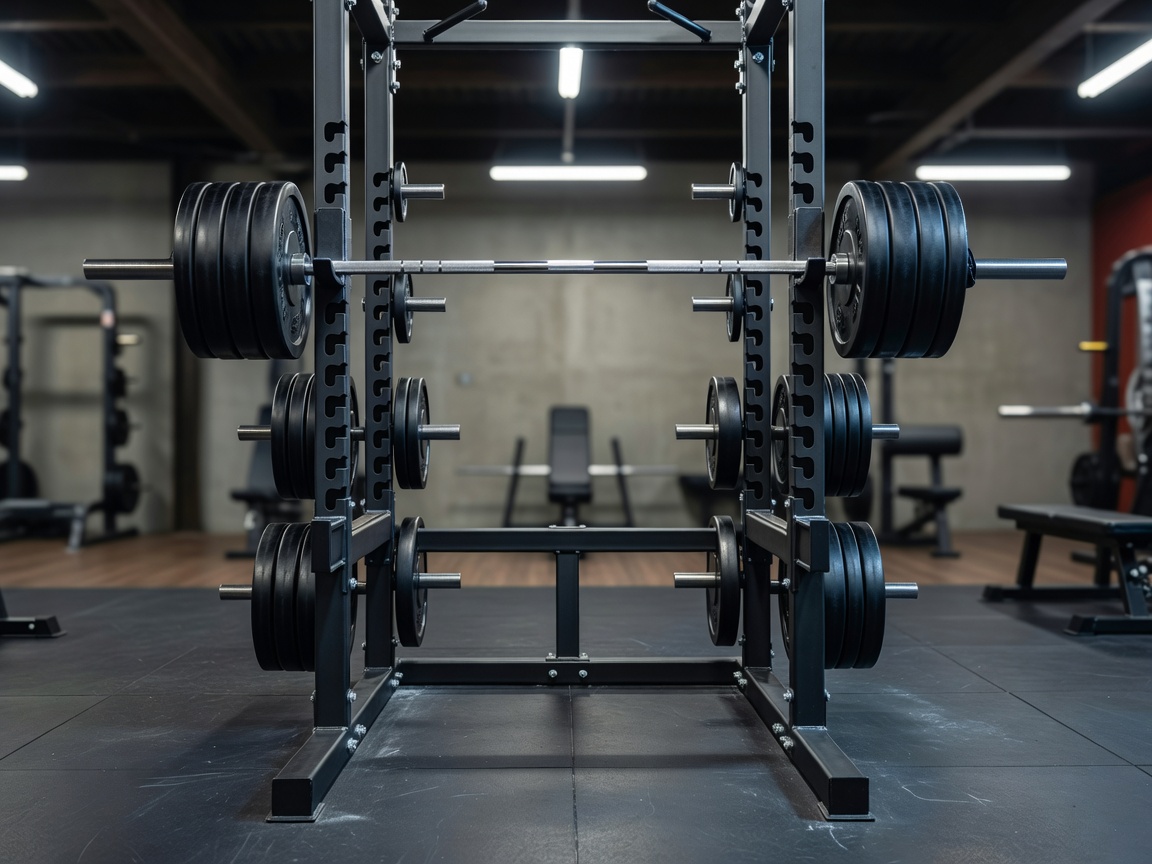
Four rack formats, four different rooms
| Format | Footprint | Solo safety | Best fit |
|---|---|---|---|
| Squat stands (two independent uprights) | Smallest; often movable by one person | Limited — spotter arms optional and less enveloping | Shared or temporary rooms, light-to-moderate loads |
| Half rack (two uprights, front spotter arms) | Moderate; front-loaded footprint | Good with correctly set arms | Garages where you want to lift outside the frame |
| Power rack (four uprights, internal safeties) | Largest, plus walk-around space | Best — you lift inside a cage with pin or strap safeties | Dedicated rooms with the height and depth for it |
| Wall-mounted folding rack | Folds to roughly the depth of the uprights | Good when correctly fixed and fully deployed | Garages that must stay usable for a car |
Two things drive the price difference inside any one format. The first is the upright profile: 2 in × 2 in and 2 in × 3 in tubing is common on home racks, while 3 in × 3 in is the commercial-style option with a deeper attachment ecosystem. The second is steel gauge, where a lower number means thicker wall — 11-gauge tube is noticeably stiffer than 14-gauge, and the difference is audible as well as measurable when you rack a heavy bar.
Then check the details that constrain you later: hole diameter (5/8 in and 1 in are the two widespread hardware standards, and attachments are not cross-compatible), hole spacing (2 in throughout, or 1 in through the bench-press range so you can fine-tune the bar start height), and whether the rack is designed to be bolted down or free-standing with a weighted base.
Pros and cons of the two most common home choices
Power rack
- Safest option for training alone to failure
- Pull-up bar, plate storage and attachments included or available
- Very stable, often without bolting down
- Holds resale value well
Folding wall rack
- Returns the floor to you in seconds
- Needs a structurally sound wall and correct fixings
- Fewer attachment options; no enclosed cage
- Fold-back depth still occupies the wall permanently
Barbells: the specification sheet decoded
A standard men's Olympic barbell is about 2.2 m long, weighs 20 kg and has 50 mm rotating sleeves. The women's version is around 2.0 m and 15 kg with a 25 mm shaft. Short bars of roughly 1.7 m exist for narrow rooms. Everything else on the spec sheet is one of five variables:
- Shaft diameter. Around 28 mm suits Olympic weightlifting and gives more whip; 28.5 mm is a common all-round choice; 29 mm and above is stiffer and favoured for heavy powerlifting.
- Tensile strength. Quoted in PSI and describing the steel's resistance before failure. Higher figures indicate a bar that tolerates repeated heavy loading without bending permanently.
- Knurling. The cut pattern that gives grip. Passive knurl is comfortable for high-rep work; aggressive knurl holds under maximal pulls and shreds hands in conditioning. A centre knurl helps back squats and irritates the neck in cleans.
- Sleeve rotation. Bushings are quieter and cheaper; needle bearings spin faster and suit the Olympic lifts. Bearings usually need more care in a damp room.
- Coating. Bare steel gives the best feel and rusts fastest. Zinc, chrome and ceramic-style coatings each trade a little grip for corrosion resistance — a real consideration in an unheated garage.
One bar covers almost everything a home lifter does. If you buy a second, make it a specialist: a trap bar for loaded carries and hinge patterns with less spinal demand, or a safety squat bar if shoulder mobility limits the back squat.
Plates: iron, rubber-coated or bumper
| Type | Diameter behaviour | Noise & floor impact | Notes |
|---|---|---|---|
| Cast iron | Thin; more weight fits on the sleeve | Loud; concentrates impact on a small edge | Cheapest per kilo; rusts if unpainted or chipped |
| Rubber-coated iron | Slightly thicker than bare iron | Quieter than iron; still not for dropping | Good compromise for mixed-use rooms |
| Crumb-rubber bumpers | Full 450 mm diameter across weights | Designed to be dropped; spreads impact | Recycled rubber; can carry a strong smell initially |
| Virgin-rubber bumpers | Full diameter; thinner per kilo than crumb | Dead bounce, quiet | More expensive; less odour, tighter tolerances |
| Calibrated steel plates | Thin, precise, competition-style | Loud; not for dropping | For tight weight accuracy, not for a garage floor |
Build the set from the bottom up. A pair each of the smallest increments plus fractional plates matters more for steady progress than another pair of the heaviest plates you can currently lift. Also match your collars to the job: spring clips are fine for pressing, while lock-style collars stay put under pulls and drops.
The bench is not an afterthought
Look at pad width (around 25–30 cm suits most people: wide enough to support, narrow enough to let the shoulder blades set), pad height with your intended flooring in place, the gap between seat and back pad on an adjustable model, and the frame's stated load rating including body weight. Flat benches are more stable and cheaper; flat-incline-decline models buy you pressing angles and introduce a hinge that can wobble. For a first purchase, a solid flat bench plus a rack beats a flimsy adjustable one every time.
A sane buying order
- Flooring appropriate to the loads you intend to drop.
- Rack that fits the measured ceiling and wall.
- One good all-round barbell and a set of lock collars.
- Plates from the smallest increments upwards.
- Bench.
- Accessories, attachments and specialist bars — later, deliberately.