Guide 05 — Upkeep
Recovery kit and a real maintenance schedule
Home gym equipment rarely dies suddenly. It gets loose, damp and gritty over a couple of years while nobody checks. Twenty minutes a month prevents nearly all of it.
The schedule
Manufacturer instructions always take precedence — lubrication requirements in particular vary, and the wrong product on a maintenance-free deck causes damage. Use this as a prompt list, not a substitute for your manuals.
| Interval | Task | Why it matters |
|---|---|---|
| After each session | Wipe sweat from pads, handles and frames; return plates and collars to storage | Sweat is corrosive; loose plates on the floor are the most common home gym injury source |
| Weekly | Sweep or vacuum the floor; brush chalk and grit off the bar and out of the knurling | Grit gets into sleeves, bearings and seat rails and grinds them |
| Weekly | Check the hygrometer reading | Rising humidity is the early warning for rust on bare steel |
| Monthly | Hand-check every visible bolt on racks, benches and machines; tighten to the manual's figure | Cyclic loading loosens fasteners; a loose bench hinge or J-cup bolt is a safety issue |
| Monthly | Inspect cables, straps, bands and pulleys for fraying, nicks or flat spots | Tension components fail suddenly and under load |
| Monthly | Wipe barbell shaft and sleeves; apply a light machine oil to bare steel if your room is damp | Prevents surface rust and keeps rotation smooth |
| Quarterly | Check treadmill belt tracking and tension; lubricate the deck only if the manual specifies it | A drifting or loose belt wears the deck and the motor |
| Quarterly | Clean rower rails and seat rollers; check chain or strap tension | Restores the smooth catch and prevents roller flat-spotting |
| Quarterly | Lift mats at the edges, check for trapped moisture, clean with a pH-neutral cleaner | Solvent cleaners degrade rubber; trapped damp corrodes the slab and the equipment feet |
| Annually | Full inspection: welds, upright straightness, pad stitching, plate coatings, console firmware, spare-part availability | Catches the slow failures while parts are still obtainable |
Humidity and rust are the real enemy
In an unheated garage or a basement, the temperature swings and the metal often sits below the dew point of the incoming air. Condensation forms on bars and plates, and bare steel starts to bloom within days. The remedies, in order of effectiveness:
- Measure. A cheap hygrometer tells you whether you have a problem; many home gym owners aim to hold relative humidity somewhere in the 45–55% band.
- Dehumidify. A domestic dehumidifier sized for the room volume, drained somewhere sensible, does more than any coating.
- Seal and cover. Sealed concrete and suitable flooring reduce moisture rising into the room; a cover over a bar left on a rack keeps condensation off it.
- Protect the steel. A light film of machine oil on bare steel bars, wiped on with a cloth and wiped back off, is standard practice. Avoid oiling grip surfaces to the point that they become slippery.
- Treat early. Light surface rust comes off knurling with a bronze or nylon brush and a little oil. Deep pitting is permanent — get there first.
Safety checks that are not optional
- Safety pins, straps or spotter arms set for the lift you are about to do, every time, when training alone.
- Collars on the bar for any pressing or overhead work.
- A clear one-metre perimeter around the working area — no dumbbells, no phone, no water bottle in the path.
- Fixings on wall-mounted racks and pull-up bars checked monthly, and immediately after any movement or noise.
- A phone within reach and someone who knows you are training, if you lift heavy alone.
The recovery kit worth its shelf space
Recovery equipment has a marketing problem: the claims outrun the evidence, and the sensible list is short and cheap. What most home gyms actually use:
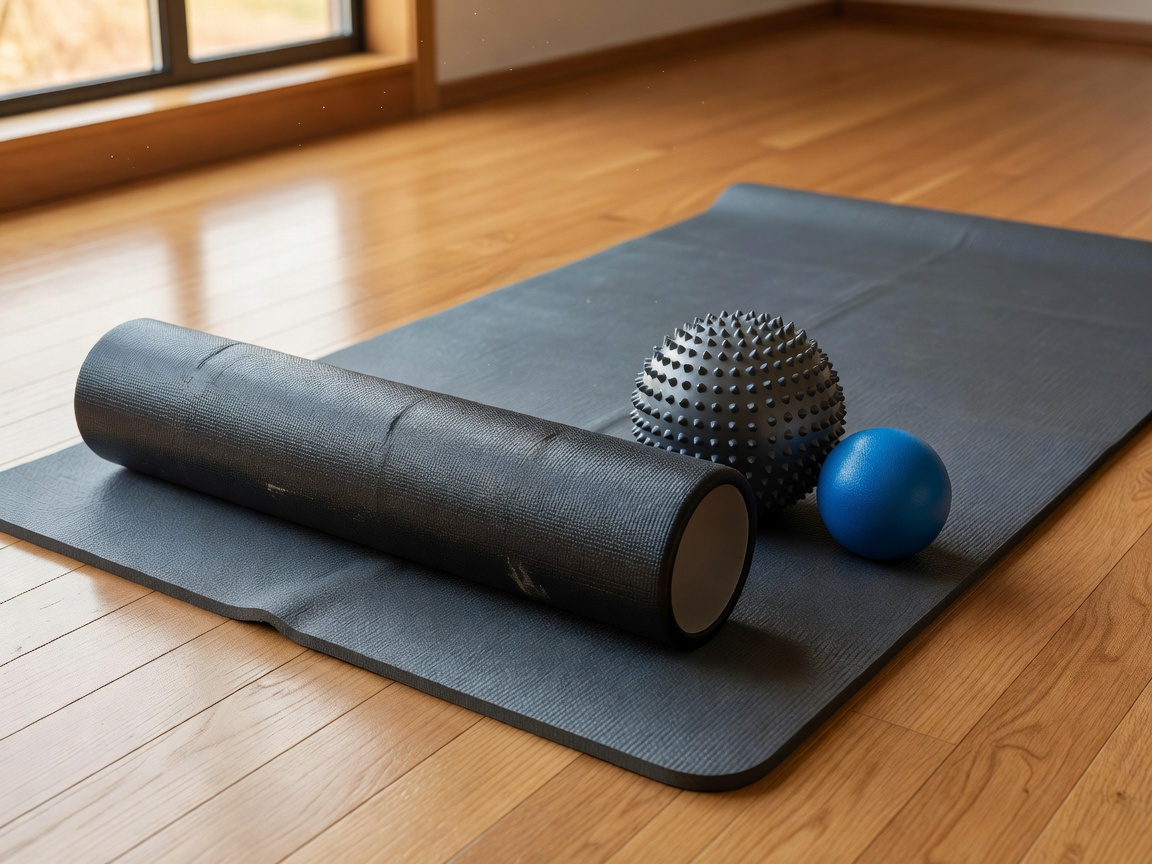
- Foam roller. A medium-density roller for large muscle groups. Firmer textured rollers are more intense but not more useful for beginners.
- Mobility ball. A firm ball for calves, glutes and the mid-back against a wall. Pressure that makes you hold your breath is too much.
- Long resistance band. Doubles as warm-up tool, stretching aid and pull-up assistance.
- A mat you are willing to lie on. The barrier to a ten-minute mobility session is usually a cold, gritty floor.
- A timer and a notebook. Structure beats equipment. Ten minutes logged beats thirty minutes intended.
Massage guns, compression boots and similar devices can feel good and some people value them; treat the marketing claims sceptically, and prioritise sleep, food and sensible load progression, which cost nothing and do the heavy lifting. Nothing on this page is medical advice — if you have pain, an injury or a health condition, ask a qualified clinician rather than a product page.
Keep a log
One page in a notebook or a note on your phone: date, what you checked, what you tightened, what you noticed. It takes seconds and it turns vague worry into a decision — you will know whether that creak is new, whether the belt has needed adjusting three times this year, and when a part was last replaced. It is also the single most useful thing to hand over if you ever sell the equipment.