Guide 03 — Cardio
Cardio machines that fit the room and the building
Cardio equipment is judged at home on three axes the showroom never mentions: how much floor it holds permanently, how much noise it sends through the structure, and how much servicing it demands.
Start with the constraint, not the workout
Write down your three hard limits before browsing: the longest dimension the machine may occupy, whether you have a suitable mains socket within reach, and who is below or beside you when you train. A machine that suits a detached garage may be unusable in a first-floor flat, and no amount of feature comparison changes that.
Seven categories, side by side
| Machine | Typical footprint | Noise character | Mains power | Routine upkeep |
|---|---|---|---|---|
| Motorised treadmill | Long and wide; some fold upright | Motor hum plus footfall impact through the floor | Yes | Belt tension and alignment; deck lubrication per manual; dust |
| Curved manual treadmill | Similar length, usually heavier | Mechanical rumble, no motor whine | No | Slat and bearing inspection; occasional cleaning |
| Air (fan) bike | Compact, tall | Loudest category — the fan is the resistance | No (battery console) | Chain or belt tension; bolt checks; very little else |
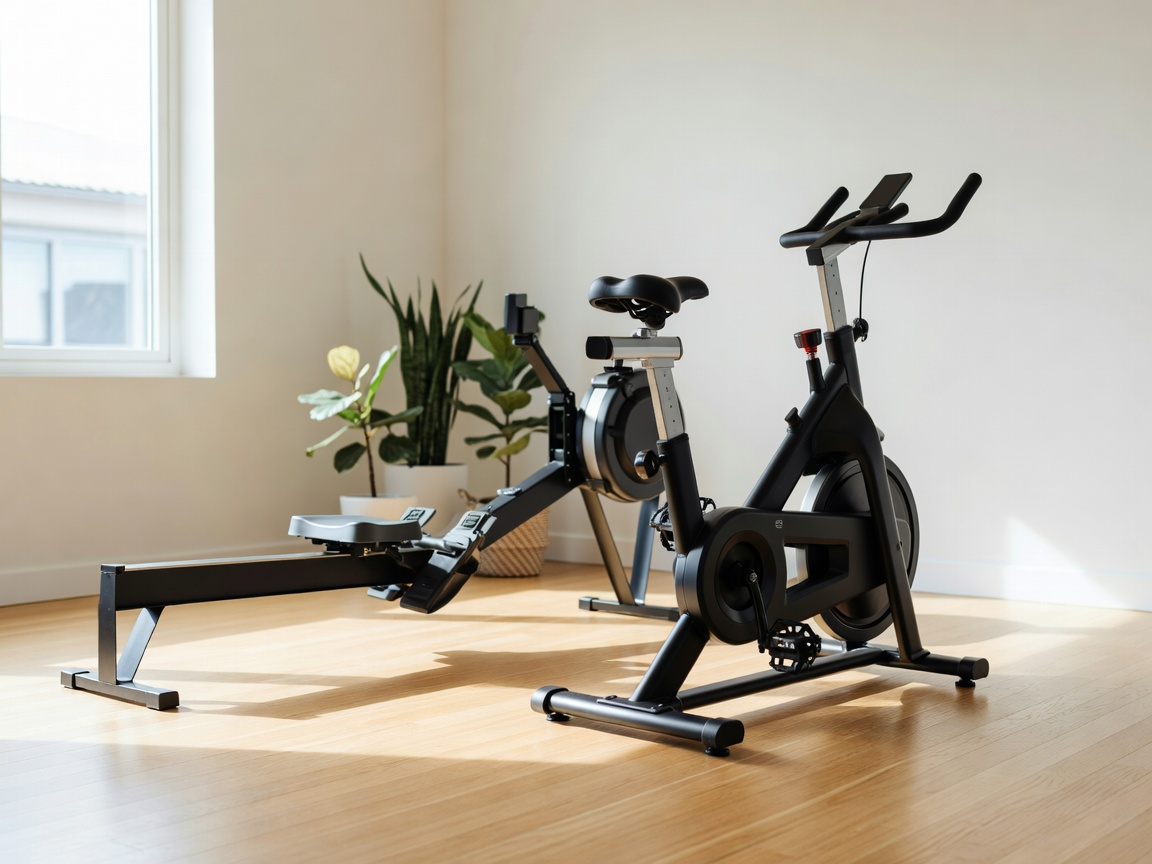
| Magnetic upright / spin bike | Smallest of all | Quietest — a low whirr | No (battery console) | Pedal and crank torque; sweat wiped off the frame |
| Rower (air, magnetic or water) | Around 2.2–2.5 m long; many split or stand vertically | Air is loud, magnetic quiet, water a wash sound | No (battery console) | Rail and seat rollers cleaned; chain oiled; water tank treated |
| Ski trainer | Very small floor area; needs height and wall fixing | Fan noise on pull | No (battery console) | Cord and pulley inspection |
| Elliptical / stair climber | Large and tall; rarely folds | Quiet drive, but tall motion needs ceiling height | Usually yes | Bearings, bolts and rail cleaning |
Treadmills: what the spec sheet is telling you
Three numbers matter more than the screen. Belt size determines whether you can run rather than walk — taller runners with a long stride generally want a longer running surface, and the belt width decides how much lateral margin you have when tired. Motor rating is usually given as continuous horsepower, and the continuous figure is the honest one; peak ratings describe a moment, not a workout. Frame weight and rating indicate how much shake you will feel at speed and the user weight the deck is designed for.
Then check the practical parts: whether the deck folds and whether the fold uses a gas strut, the stated overall dimensions when folded, the transport wheels, and the maintenance instructions. Some decks require periodic lubrication, some are specified as maintenance-free, and using the wrong product on either will cause damage. On a suspended timber floor, footfall impact is transmitted downwards; a dense mat under the machine helps, but a treadmill directly above a bedroom will still be noticed.
Pros and cons of the two most popular home choices
Rower
- Full-body, low-impact, easy on downstairs neighbours
- Many models separate or stand vertically for storage
- No mains power needed on most units
- Very durable with minimal servicing
Treadmill
- Most transferable to outdoor running and walking
- Largest permanent footprint of the common options
- Needs mains power and a service routine
- Footfall noise is structural, not airborne — hard to fix
Noise, ranked from friendliest to worst
- Magnetic bike — a hum you can hold a conversation over.
- Magnetic or water rower — rhythmic but soft; the seat rail is the main noise.
- Elliptical or stair climber — quiet drive, occasional creak as bearings age.
- Curved manual treadmill — a mechanical rumble, no motor.
- Motorised treadmill — motor plus repeated impact into the floor structure.
- Air bike or ski trainer — a jet of air that carries through doors and walls.
If the building is the constraint, buy quiet on purpose. A magnetic bike on a rubber mat in a flat gets used; an air bike in the same room gets used twice.
Consoles, subscriptions and data
Decide whether you want a screen at all. A machine that exposes its data over a standard fitness protocol can talk to apps and watches you already own, which keeps the machine useful if a manufacturer's platform changes. A machine whose training content is locked behind a proprietary subscription is a longer-term commitment than the purchase price suggests — check whether basic resistance control and metrics still work without an active plan, and confirm the terms in the manufacturer's own documentation before buying.
Buying used
Cardio machines depreciate fast and the second-hand market is large. Inspect rather than trust: run the machine through its speed and resistance range, listen for bearing noise, check the belt for fraying and tracking drift, look for rust at the frame welds, confirm the console powers up and that a replacement console or power supply is still obtainable. Ask how it was stored — an unheated garage is harder on electronics than a spare bedroom. And measure your doorways before agreeing to collect; a rower is long and a treadmill is heavy and awkward, and neither disassembles as easily as you hope.
A workable default
For a small room with neighbours, a magnetic bike plus a jump rope covers conditioning with almost no footprint. For a garage with height and a concrete slab, a rower and an air bike between them cover steady state and intervals with essentially no maintenance. A treadmill earns its space only if walking or running is the point, and if the floor below it can take the impact.