Guide 04 — Small spaces
Small-space and apartment gear
A flat, a spare bedroom or a shared living room can support serious training. It just has to be gear that stores flat, lands quietly and works in a two-metre square.
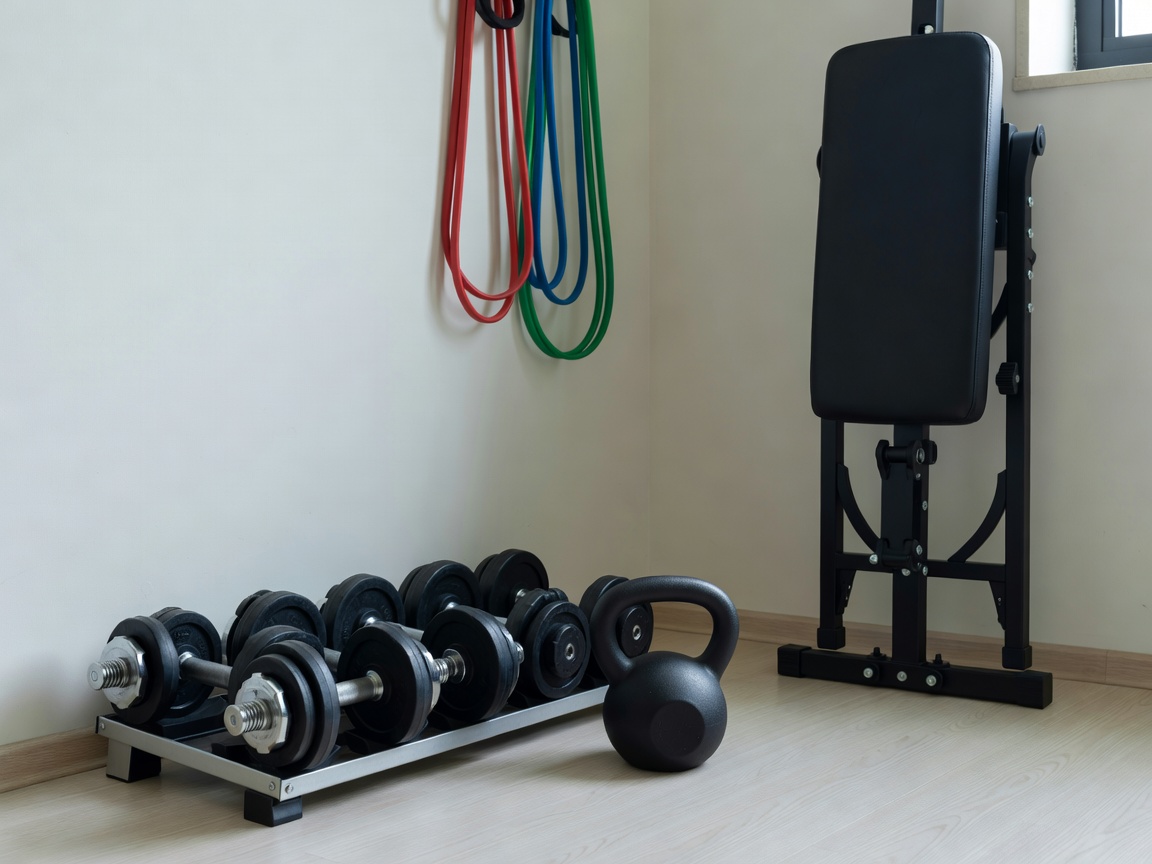
The three constraints that decide everything
- Storage volume, not floor area. If the gear cannot disappear into a cupboard, under a bed or onto a wall in under two minutes, a shared room will reclaim it.
- Impact transfer. On a suspended timber floor, dropping anything transmits straight to the room below. That rules out dropping weights and heavily favours controlled, non-ballistic movements.
- Ceiling and wall integrity. Overhead pressing, jump variations and any pull-up fixing depend on what is above and behind the plasterboard.
Adjustable dumbbells: three mechanisms
Adjustable dumbbells are the single highest-value purchase for a small room, because one pair replaces a rack of fixed weights. There are three mechanism families, and they fail in different ways.
| Mechanism | How it changes weight | Strengths | Weaknesses |
|---|---|---|---|
| Selector pin / tray | Dial or pin engages plates held in a cradle | Fast switching mid-workout; tidy | Long overall handle at heavy settings; must be returned to the cradle; plastic parts in the mechanism |
| Twist-lock dial | Rotating the handle or end cap locks plates | Very fast; compact shape at light settings | Fewer increments on some designs; needs careful seating |
| Plate-loaded with collars | You add standard plates and lock a collar | Cheapest; no proprietary parts; almost unbreakable | Slow to change; more small parts to store and lose |
What to check before buying: the increment size at the range you actually train in, the total length of the loaded dumbbell (a long handle fouls the ribs on a floor press), the maximum weight per hand, whether a heavier expansion kit exists, and whether the mechanism tolerates being set down firmly. Most selector-style dumbbells are explicitly not designed to be dropped, and the mechanism is where they break.
Kettlebells, bands and suspension
A small kettlebell ladder — for example moving up in 4 kg steps — covers swings, carries, presses and squats with almost no footprint. Cast-iron bells with a smooth handle and a wide window suit two-handed work; competition-style steel bells share a constant size across weights, which keeps the rack position identical as you get stronger. Adjustable kettlebells exist and save space, but the plate stack makes the bell bulkier against the forearm.
Resistance bands are the cheapest useful thing in this guide. Loop bands add resistance to bodyweight squats and presses, pull-up assistance bands make the movement trainable, and light therapy bands cover shoulder and hip warm-ups. They also degrade — check for nicks and store them out of sunlight, away from radiators, and never stretch a band across your face.
A suspension trainer anchored to a door or a properly rated ceiling fixing gives rows, presses, splits and core work from a package that stores in a drawer. Rows are the exercise most small home gyms lack, and this is the cheapest way to get them.
Pros and cons of going fully minimal
In favour
- Fits any room, moves house in a car boot
- Quiet enough for evening training in a flat
- Low total cost; little to maintain
- Nothing needs bolting to a wall
Against
- Heavy lower-body loading is hard to reach with dumbbells alone
- Increments are coarse compared with fractional plates
- Progress often shifts to tempo and reps rather than load
- Setup and pack-down friction on every session
Benches, bars and wall-mounted options
A folding bench that stands vertically against a wall is worth more in a small room than a heavier flat bench, provided the frame rating covers your body weight plus the load you will hold. Check the pad thickness and the stability of the hinge under an incline press — that hinge is where cheap folding benches wobble.
If you have a wall you are permitted to drill and can verify the structure behind it, two options change what is possible: a wall-mounted folding rack, which gives a real squat and bench setup and folds to roughly the depth of its uprights, and a properly fixed pull-up bar. Doorway pull-up bars that rely on leverage against the frame are convenient but depend entirely on the frame and the fit; inspect the door frame, follow the instructions precisely, and treat a bar that shifts as unsafe. For renters, a floor-standing pull-up frame with a wide base avoids fixings altogether at the cost of footprint.
Keeping it quiet
- Train barefoot or in flat shoes, and land softly — pick step-ups over jumps.
- Put a dense mat under the working area, not a thin foam sheet.
- Set weights down rather than releasing them; choose gear rated for controlled placement.
- Swap swings and slams for carries, holds and slow eccentrics late in the evening.
- Talk to the neighbours before they have to talk to you, and agree training hours.
A starter list that fits one shelf
- One pair of adjustable dumbbells with increments suited to your current lifts.
- One mid-weight kettlebell, then a second heavier bell later.
- A dense exercise mat sized for your tallest movement.
- A suspension trainer or a rated pull-up option for pulling work.
- A set of loop bands plus one long band for assistance and warm-ups.
- A folding bench, once the rest is genuinely getting used.